
Key Facts
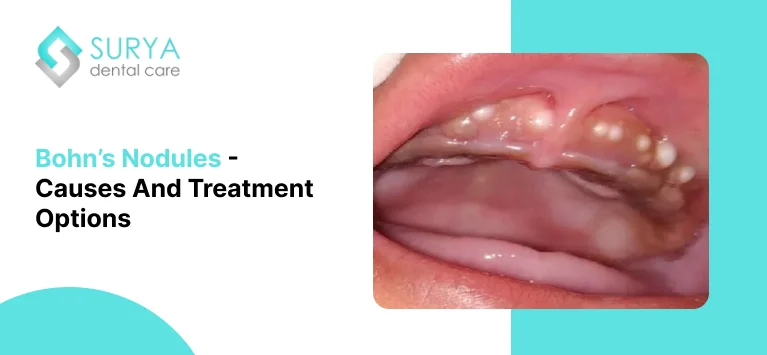
- Bohn’s nodules are harmless white or yellow cysts found on the gums of newborns, seen in about 70–80% of infants.
- They are not painful, don’t interfere with feeding, and usually disappear on their own by 3 months of age.
- Easily confused with Epstein pearls—difference is location: Bohn’s nodules form on alveolar ridges, Epstein pearls on the palate.
- No treatment is required. Parents should avoid rubbing, popping, or applying home remedies.
- Consult a pediatric dentist if bumps persist beyond 6 months, grow, change color, or cause discomfort.
You examine a newborn’s mouth and notice small, white bumps along the gums. They’re not teeth or oral thrush, and they don’t seem to bother the baby. You’re likely seeing Bohn’s nodules, a common, benign oral finding in infants that usually resolves without any treatment. So you need not worry about them. Please continue reading to learn about what it is, why it is formed when it goes away, and whether it is painful for babies.
How Common Are Bohn’s Nodules?
Bohn’s nodules are seen in roughly 70 to 80 percent of full-term newborns. They often go unnoticed unless a parent or clinician spots them during feeding or a check-up.
These nodules typically appear within the first few days or weeks of life and are considered completely normal. They present as tiny, firm, white, or yellowish cysts on the alveolar ridges, either on the cheek side (buccal) or tongue side (lingual) of the gums.
Are Bohn’s Nodules Painful?
No, they are not painful. Bohn’s nodules don’t cause discomfort, swelling, or feeding issues.
They remain asymptomatic, so the baby won’t even notice they’re there. If an infant seems fussy during feeding, the cause is likely something else, like oral thrush, teething, or reflux, and it is not due to these harmless cysts.
Epstein Pearls vs Bohn’s Nodules
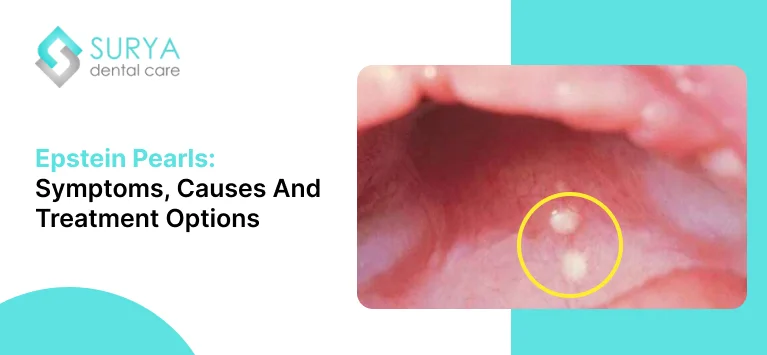
It’s easy to confuse Epstein pearls with Bohn’s nodules, but their location and origin set them apart.
Epstein pearls occur on the midline of the hard palate and arise from trapped epithelial cells during fetal development. Bohn’s nodules, by contrast, appear along the alveolar ridges and are believed to originate from remnants of the dental lamina or minor salivary glands.
Both are benign, both resolve independently, and neither require intervention. That said, correctly identifying the location helps reassure parents and rule out less common oral anomalies.
When Do Bohn’s Nodules Go Away?
Bohn’s nodules typically disappear when the baby is three months old, sometimes even earlier. The body naturally absorbs or ruptures the cysts over time.
If they persist beyond six months or begin to look different—larger, inflamed, or clustered—it’s worth reevaluating the diagnosis. But in most cases, they vanish quietly without leaving a trace.
Bohn’s Nodule Treatment – Do They Need It?
Bohn’s nodules do not need treatment. They are harmless, don’t interfere with feeding, and don’t pose any risk to the baby’s development.
Attempting to pop or rub them can cause irritation or infection, which turns a non-issue into a clinical problem. Applying home remedies or over-the-counter ointments won’t help and may worsen things.
The best course of action is to observe and reassure. If the bumps remain white, firm, and unchanged, they should be left alone. Any changes in color, swelling, or discomfort should prompt a closer look, but until then, no treatment is necessary.
When Do You Need to Worry?
In general, you don’t.
But if the nodules are still present after six months, show signs of infection, bleed, or start to grow, a referral to a pediatric dentist or pediatrician is appropriate. These changes may suggest it’s not a Bohn’s nodule after all.
Differential diagnoses might include oral thrush, mucoceles, or even natal teeth—but these conditions look and behave differently. Oral thrush, for example, wipes off and often comes with fussiness and feeding problems. Mucoceles may appear soft and bluish. Natal teeth are firm, erupt through the gum, and usually occur in the lower front jaw.
Misdiagnosis is rare if the clinical features are clear and the timeline fits.
What Should Parents Do?
Nothing—except maybe take a deep breath.
Once Bohn’s nodules are correctly identified, parents should be advised not to poke, rub, or treat them. They should continue regular oral care, such as gently wiping the baby’s gums with a soft, damp cloth after feeding.
The nodules require no medication, dental procedure, or special care. The safest and most effective approach is to let them resolve on their own.
And if you’re the clinician delivering the news, keep it brief and confident: “They’re common. They’re painless. They’ll go away.”
So Why Do They Matter at All?
Because parents Google everything, and in the age of online diagnoses and baby forums, even harmless things can spiral into anxiety.
As a clinician, recognizing and explaining Bohn’s nodules calmly helps build trust. It also prevents unnecessary referrals, medications, or procedures. Better yet, it teaches new parents to distinguish between what’s normal and what’s not—one less thing to worry about during a sleep-deprived stage of life.
Takeaway
Bohn’s nodules are harmless, self-resolving, and incredibly common. They’re not painful, not dangerous, and not a reason to panic.
Even though Bohn’s nodules are harmless, it’s a good idea to examine your baby’s mouth by a pediatric dentist or your family dentist during their first dental visit by age one, as the American Academy of Pediatric Dentistry (AAPD) recommends. Contact the best kids dentist in Trichy at Surya Dental Care to get your child’s pediatric care.