

If you’ve ever looked in the mirror and noticed odd map-like shapes on your tongue, you’re not imagining it. That’s geographic tongue. It’s real, it’s common, and it looks stranger than it is. Continue reading the blog to know more about what causes it, how it behaves, and when to care.
Glossitis and Geographic Tongue: What Is It?
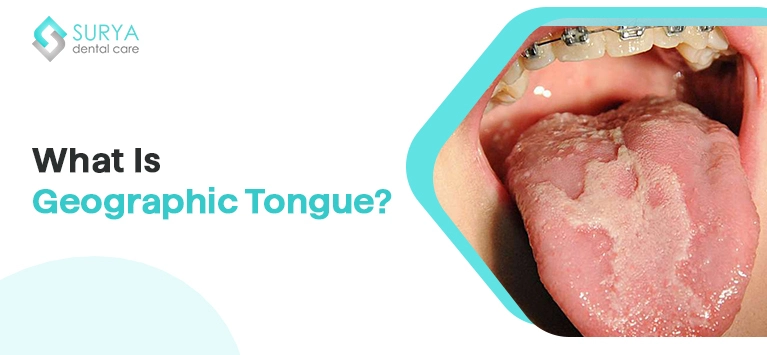
Geographic tongue, also called benign migratory glossitis, is an inflammatory condition affecting the surface of your tongue. You’ll see smooth, red patches bordered by a white or pale margin. These areas shift in shape and location, sometimes daily. One day the patch is near the tip. A week later, it’s hugging the edge.
The reason? Loss of filiform papillae, those fine projections that give the tongue texture. They vanish in some spots, creating those glossy red patches. The “geographic” label comes from their resemblance to a topographic map.
Some people also develop patches on the cheeks, gums, or the roof of the mouth. When that happens, it’s called geographic stomatitis.
Geographic Tongue Causes: Why Does It Happen?
Nobody knows for sure. But there are some usual suspects,
- Genetics: It often runs in families.
- Fissured tongue: There’s a strong association between the two.
- Psoriasis: The overlap in histology and immune markers is striking enough that some researchers call it an oral form of psoriasis.
Other potential triggers
- Nutritional deficiencies especially in B-complex vitamins, iron, and zinc.
- Allergic tendencies like eczema, asthma, allergic rhinitis.
- Psychological stress has been linked with flare-ups.
- Hormonal changes like fluctuations, including pregnancy or birth control use, might influence symptoms.
- Systemic diseases like diabetes, celiac, inflammatory bowel disease, HIV.
- Smoking—or rather, not smoking. Curiously, smokers seem less likely to develop it. That’s not a prescription, just an observation.

Geographic Tongue Inflammation: What Does It Feel Like?
Sometimes, nothing. Many people never notice it until a dentist points it out.
But if you’re symptomatic, here’s what you might feel
- A mild burning sensation.
- Sensitivity when eating spicy, salty, acidic, or hot food.
- Discomfort with toothpaste, especially ones with harsh additives like sodium lauryl sulfate.
The symptoms come and go. They might stick around for weeks, disappear without notice, and reappear months later.
What It Isn’t
- It’s not contagious.
- It doesn’t turn into cancer.
- Despite how it looks, it’s not a fungal infection. If you see white patches that scrape off easily or bleed underneath, that’s something else like candidiasis.
Diagnosing Glossitis and Geographic Tongue
Most of the time, a simple visual exam is enough. The pattern is distinctive. Your dentist or physician might poke around and ask if it burns or changes location. If it looks classic, you won’t need a biopsy.
If it doesn’t, or if it persists in one area without changing, they might want to rule out lichen planus, leukoplakia, erythroplakia, or even oral cancer. In rare cases, a small tissue sample can help exclude those.
Geographic Tongue Treatment: How to Manage It
There’s no cure. But you don’t need one either. The condition is harmless.
If it’s painless, do nothing. If it’s annoying, here’s what can help
- Avoid triggers. Spicy food, acidic fruit, alcohol, salty snacks, and toothpaste with aggressive detergents can make it worse.
- Switch toothpaste. Choose one made for sensitive teeth. Avoid SLS, whitening agents, and strong flavors.
- OTC pain relief. Mild anti-inflammatories like ibuprofen or naproxen can help.
- Topical treatments. If irritation is severe, your dentist might prescribe corticosteroids, antihistamine rinses, or topical tacrolimus.
- Zinc or B-vitamin supplements. Only if you’re deficient.
Again, none of this “treats” geographic tongue. It just calms things down while your immune system does its work.
When Should You Worry?
You shouldn’t. But if lesions don’t move, grow rapidly, or bleed, see a doctor. Same if your tongue changes color dramatically, especially to blue, purple, or black.
If you can’t eat, talk, or swallow comfortably or if your lymph nodes swell up it’s time for an evaluation.
Living With Geographic Tongue
It can be frustrating. It looks bizarre, and in some cases, it feels worse than it looks. But remind patients (and yourself): it’s benign. Most cases come and go unpredictably and require no intervention.
Takeaway
Geographic tongue is a visual oddity, not a threat. It’s inconvenient, not dangerous. If symptoms flare, manage them. If you’re not sure it’s geographic tongue, check with a professional. The mouth reflects many systemic conditions, but sometimes, it’s just a map that needs no legend. Contact Surya Dental Care for treating geographic tongue from experienced dentists.
FAQs
Geographic tongues appear as smooth, red patches that can change shape and size over time, often with a white or yellowish border. The patches are caused by the loss of the small bumps (papillae) on the tongue's surface, giving it a map-like or geographic appearance.
No, geographic tongue is a harmless and non-contagious condition. While the appearance of geographic tongue can be unsettling, it is a common and benign condition that does not pose a risk to others.
Geographic tongue is not bad as it is believed to be caused by an autoimmune response, and it is not contagious. In the vast majority of cases, geographic tongue does not cause any discomfort or complications, and it is considered a normal variation in tongue appearance.
Geographic tongue is also referred to as Glossitis migratory, Erythema migrans, Benign migratory glossitis, Wandering rash of the tongue.
While geo tongue can cause discomfort and a distinctive appearance, it does not typically cause pain or serious health concerns. In most cases, geographic tongue does not require treatment, and the condition is manageable with proper oral hygiene and avoiding potential irritants.